Showing posts with label Dinner. Show all posts

Thursday, April 18, 2013

Experiment 15: Roasted Corn, Red Pepper, & Tomato Chowder

Figure 1.  See the little dots in the soup?  That's perfection.

Introduction
A little while back, we tried our hands at tomato soup.  As you hopefully don't remember, it wasn't one of our proudest moments (we provide you with the link to the associated article not to remind you of our results, but merely for the sake of continuity).  It was a bit of a disaster.  It took a good day or two to admit it, but we screwed up the recipe pretty badly.

But alas!  We are graduate students!  We are used trying and failing!  We can't give up!  Without the discipline of our graduate education in our back pockets, we may have succumbed to defeat.  But no, for us, the next logical step was to try something even harder, and prove to ourselves that it can be done.  Yes!  We can make tomato soup!  Tomato, roasted red pepper, corn, delicious!  LET'S DO IT!

Don't stop reading!   We didn't write this to flaunt our achievements.  We promise this one is a better story.  Actually, this soup was actually pretty delicious.  We even had a third, unbiased person taste it, and she loved it.

NFPA Ratings:
Figure 2. Our NFPA ratings for roasted corn, red pepper,
and tomato chowder.


Prep time: 2 hours.  This recipe took forever.  For something disarmingly complex despite its simple appearance, as this soup was, we felt that it took more time than it should have. Tons of chopping, too many steps, lots of places to mess up.  Fortunately, after all that, the result was super delicious.

Difficulty: 7.  Perhaps this ties into our rant over taking two entire hours to cook this.  It felt like a never-ending recipe with a million steps.  And then the blender issues....Oh, the blender issues.  Maybe we should take the difficult up to 8 or 9.  On the other hand, it might be better to just get a blender that has a lid (See Results).

Course: Dinner, lunch, whatever.  Soup is a side.  We tried eating this as a main course because we didn't feel like cooking anything else after putting so much effort into this soup.  Honestly, it was lucky that we also made sea salted caramel brownies that evening, because soup, no matter how many veggies you stuff into it, is not a main course.

Materials
Figure 3.  Photo cropped on purpose to hide pathetic grill.
Red Bell Peppers - 3 halved and seeded
Shucked Corn - 3 ears
Tomatoes - 1.5 lbs (about 4) halved, seeded, and peeled
Extra-Virgin Olive Oil - 2 tbsp
Chopped Onion - 4 cups (about 2 medium)
Fat-Free, Low-Sodium Chicken Broth - 3 14 oz. cans
Salt - 0.25 tsp
Freshly Ground Black Pepper - .25 tsp
Crumbled Blue Cheese - 0.25 cup (1 oz)
Chopped Fresh Chives - 2 tbsp

Methods
1) Set your grill on to medium  heat.
2) Arrange bell peppers, skin side down, and corn in a single layer on the grill rack.  Grill for 5 minutes, turning occasionally.
3) Add tomatoes to the grill, skin side down.  Grill for 5 more minutes, or until the vegetables are slightly charred.
4) Remove from heat, cool for 10 minutes.
5) Coarsely chop the tomatoes and peppers and place them in a medium bowl.  Cut the kernels from the corn and add them to the bowl.
6) Heat oil in a large Dutch oven (or pot with a well-fitting lid).
7) Add the onion and cook for 7 minutes or until the onion is tender.  Add the tomatoes and cook for 3 more minutes, stirring occasionally.
Figure 4. Tomato, corn, pepper, onion, sliced and seeded.
8) Increase the heat to high and stir in the broth.  Bring to a boil.
9) Reduce heat and simmer for 30 minutes or until the vegetables are tender.  Cool for 20 minutes.
10) Place 1/3 of the tomato mixture in a blender, PUT THE LID ON, and process until smooth.  Put the pureed mixture into a large bowl.
11) Repeat step 10 twice (until the whole mixture is pureed).
12) Wipe Dutch oven (or pot) clean with paper towels.
13) Push the tomato mixture through a sieve/colander/strainer and discard the solids.
14) Place Dutch oven (or pot) over medium heat and cook thoroughly
15) Stir in the salt and pepper

Yield: Six 1.5 cup bowls of soup
Top each with 2 teaspoons of cheese and 1 teaspoon of chives (optional...aka we forgot this part.  We bought chives, but then forgot to use them.)

Results
Here's a useful tip: when you're cooking something, read the entire recipe carefully before you start.  When the recipe asks for a blender, don't just say "oh, I have that."  Make sure you have all of the components, including the lid.  When we reached step ten, we casually pulled out the blender, set it down on the counter, then stepped back in horror upon realizing that the lid was not present.

Figure 5. The effect of lid presence on the total kitchen
surface area splattered with boiling hot tomato-infused
chicken broth, as a function of the angular velocity of the
blender blades.
See, this is where being a scientist doesn't help.  Engineers build working systems from scratch, but as biologists, we are taught to take
the opposite approach, that of taking a whole working system and manipulating it in some way to see what changes.  Therefore, in this case, our graduate education does not apply to this sort of dilemma.  Don't worry, we don't lack quite enough common sense to "test" what happens when you use a blender without a lid and swirl sharp blades at a very high velocity through a boiling hot mixture contained within it (See Figure 5 for the predicted results from such an experiment).

No, we tried to come up with other kitchen supplies to substitute for a lid.  It was definitely one of our worst ideas thus far.  Enter: cutting board.  A small, smooth (minus a few slice marks), thick, plastic, board with rubber edges for a no-slip grip.  A perfect substitute for a blender lid?  Not hardly.

It was a beautiful piece of teamwork: one of us applied pressure to the cutting board while the other managed the controls.  Bzzz..bzzz..bzzzzzzzz.  It was working.  With every turn of the blade came greater confidence in our last-minute lid substitute.  But all of the sudden, "SPLOOSH!"  The blender hiccuped, and sprayed boiling hot tomato corn pepper soup puree through the air onto every surface in a two foot radius.  None hit the skin though, fortunately.  No, that happened during the first repetition of the first part of step 10.  It was only a minor burn.  It's all better now.

Don't try this at home.  Seriously, don't.

Figure 6.  Yummy in our tummies!
Where there is no harm, there is no foul.  Who is thinking about 1st degree burns anyway when they're eating such a delicious chowder?  It provided the taste buds with an immaculate mixture of flavors, with each ingredient making its presence known in a subtle but succulent fashion.  We forgot to peel the tomatoes, which produced a bit of a texture in the soup.  It wasn't bad; in fact, it added a little character to the dish (bowl?).  All in all, we feel that we redeemed ourselves from our previous effort at cooking tomato soup from scratch.  While the process itself could have used much refinement, the final product outscored and conquered our first iteration, wiping it clean from our minds (but not from the counter).


Discussion The kitchen is full of hot surfaces and substances, e.g. the pots on your stove, the racks in your oven, the boiling hot oils in your frying pan, and the silverware straight out of your dishwasher.  It is sometimes a wonder that we made it this far in the first place.   In this case, the burn came from transferring boiling hot chicken broth from a pot on the stove to a blender sitting a foot away.

So...this is kind of gross, but if you follow our recipe exactly, then it's only fair that we tell you a little about how to deal with a burn.  First of all, a first degree burn is a surface burn of the skin, and it can be caused by heat, radiation, chemicals, friction, or electricity.  In this case, the burn result from concentrated heat exposure.  Generally, with a minor burn, the affected skin will turn red and hurt.  Rest assured, these minor burns should heal in 2-3 days (Granger 2009).  For anything more serious, you would probably need medical attention.  However, unless you pour the entire pot of soup on yourself, you shouldn't worry about that.

Figure 7. Layers of the Skin
Your skin layers include the epidermis, which is the outermost layer, the dermis, which is the middle layer, and the hypodermis, which is the innermost layer of skin (Figure 7).  First degree burns usually only affect the epidermis.  Anything lower than the epidermis (muscles, blood vessels, etc.) would only be affected by a more severe burn.  Throughout these layers, for example in your fingertips, you have sensory receptors that help you feel things you touch.  These receptors indicate properties like temperature, texture, and pressure.  These properties are integrated in your brain, which allows you to identify things by touch alone.  Some receptors give you information about the onset, offset, and changes of these properties, and still others respond to prolonged, ongoing stimulation.

In the case of painful extreme temperature contact, the role of these receptors is to help you move away from painful stimulus in order to prevent injury.  The process is pretty cool, and doesn't even require your brain to get involved until after you're safely away from harm.  For example, think about accidentally touching a hot frying pan.  You jump back right away without even thinking about it.  Sensing and responding to the heat of the frying pan with a retraction of your hand is all mediated in the spinal cord.  It is only later (milliseconds later) that this sensory information is sent to your brain for you to become aware of what just happened and say, "Ow!  That hurt!"  The same thing happens when you blend boiling soup without a blender lid and it goes flying everywhere.  The soup hits skin, the skin burns, and you jump back in alarm, thus allowing even more soup to escape from the blender.  Yeah...we're awesome cooks.  :)

References
1. Weir J. "Roasted Corn, Pepper, and Tomato Chowder." myrecipes.com. June 2009.
2. Granger J.  "An Evidence-Based Approach to Pediatric Burns". Pediatric Emergency Medicine Practice 6 (1). January 2009.

Tuesday, January 29, 2013

Experiment 13: Tomato Soup

Figure 1. Tomato Soup
Introduction
Although the year is new, the winter is not.  It's cold and dark (but not much snow!)  We wanted to make something simple and warm, just enough to bring us back from the winter doldrums.  We chose a simple tomato soup.

We dream to eventually cook a fancy and complex soup, with roasted and pureed vegetables, something that takes more than a couple steps.  However, it's winter, and it was a long day, so we decided to push our dreams off for some other day.  How's that for a cheerful, uplifting thought?


Figure 2. Our NFPA Ratings for tomato soup.
NFPA Ratings:

Prep time:
 One hour and 20 minutes.  Most of that time is spent dicing tomatoes and cooking.  The steps in between don't take up much time.  The recipe claimed it would take much less time than it actually did.

Difficulty: 5.  The recipe was a bit confusing.  Maybe our reiteration of the recipe will knock this rating down a point or two, but we want to report our experiences as they happened.  (Get ready to read about some weird soup.)

Course: Dinner or lunch, but it needs to be paired with a main course.  We suggest grilled cheese.

Figure 3. Simmering the Diced Tomatoes
Materials
Tomatoes - 4 cups, diced (Figure 3)
Onion  - 1 slice
Cloves - 4 whole
Chicken Broth - 2 cups
Butter - 2 tbsp
All-Purpose Flour - 2 tbsp
Salt - 1 tsp
White Sugar - 2 tsp (or to taste)

Methods 
1. In a stockpot, over medium heat, combine the tomatoes, onion,  cloves, and chicken broth
2. Bring to boil, and gently boil for about 20 minutes to blend all of the flavors.
3. Remove from heat and run the mixture through a food mill into a large bowl or pan.*  Discard leftover bits from the food mill.
4.  In the stockpot, melt the butter over medium heat.
5. Stir in the flour to make a roux,** cooking until the roux is a medium brown.
6. Gradually whisk in a bit of the tomato mixture, so that no lumps form, then stir the rest.
7. Season with sugar and salt, and adjust to taste.

*We used a strainer and mashed it through.  Big mistake.  (See Results)
**A roux is a homemade thickening agent that is common in French cooking.  Just stir until it is evenly mixed.

Results
Well...okay.  Let's talk.  It's not like we didn't try.  We were just so excited about cooking that we failed to read the recipe closely in advance.  If we had, we would have noticed that we needed a food mill.  Instead, we skimmed the directions, and as a result, were forced to improvise after we learned of the integral role of this mystical apparatus.

Figure 4. NOT a substitute for a food mill.
What is a food mill?  It's part blender, part juicer, and part strainer.  Basically, it's used to make purees by blending vegetables into a liquidy pulp. And neither of us has one.

Coming off of a string of successful cooking escapades, our hubris overcame us, and we thought we could somehow manage without the food mill.  We quite mistakenly thought we could mash our tomato mixture through a strainer and get similar results, mostly because we had not idea what a food mill was.  Don't try it.  It won't work.  Basically, 75%  of the taste of the soup came from the chicken broth, and only 25% came from the tomato mixture.  This happened because more of the tomato was supposed to be blended into the broth.  Because of our half-baked idea (pun intended) to substitute a plastic strainer for the raw power of metal blades, the chicken broth remained the dominant flavor in the soup.  Put simply, our tomato soup tasted like chicken.  Yikes!

That is not to say it did not taste good.  It was still rather tasty...but maybe a bit salty.  Actually, it only tasted good when we dipped the grilled cheese in it, which toned down the chicken flavor and put the emphasis on fried bread and cheese.  Grilled cheese was really our saving grace in this endeavor.  This recipe seemed like a lot of work for basic tomato soup, but maybe that's just because we didn't have a food mill.

Figure 5. Tomato Soup with Grilled Cheese
One last comment.  About the cleanup - it was odd.  The soup sort of gelatinized and stuck to all of the dishes.  It was very gooey and hard to scrub.

Was it worth it?  We leave that to you to decide.


Discussion
One ingredient we found surprising and problematic in this recipe was chicken broth.  Why would tomato soup use chicken broth?  Isn't tomato soup supposed to be a vegetarian dish?  Why not just use water?  So we decided to look further into the matter.

First of all, do you know what's actually in chicken broth?  It's a little gross...you might not want to keep reading.  Chicken broth is full of gelatin, which you'll know is made from hydrolyzed collagen if you read our post on thickening agents.  Remember the gummy bears?  Gelatin is a shared ingredient between chicken broth and gummy bears.  Doesn't sound so tasty anymore?  Then you should additionally know that collagen can be found in bones, tendons, cartilage, connective tissues, etc (Priest 2010).  A vegetarian's nightmare!  Good thing neither of us is a vegetarian.  Actually, don't get up-in-arms about this apparent travesty just yet.  Sources tell us that store-bought chicken broth doesn't contain as much hydrolyzed protein as homemade broth.  Yes, you read that right.  Store-bought broth has less bones, tendons, cartilage, connective tissues, etc. than the homemade stuff.

Figure 6. Chicken Broth
So, why is chicken broth so much more commonly used than vegetable broth?  At first we thought that using vegetable broth would have been nice because our tomato soup wouldn't have tasted like chicken.  However, after reading a Cook's Illustrated review of store-bought vegetable broth, we understood why it may be "disastrous" for your recipe.  According to this article, vegetable broth flavors vary widely (Cooks Illustrated 2008).  Some are loaded with salt, some are sweet, some have floating veggie bits in them, some are opaque, some are clear, some are bland, and others are overpowering and leave a weird aftertaste.  That's quite a lot of variation to introduce into your recipe, especially if you don't know which particular flavor of vegetable broth you have.  The article also points out that vegetable broth is often made from the worst vegetables just before they spoil, like KFC's chicken (Cooks Illustrated 2008).  In other words, if the vegetable isn't good enough to be sold as a vegetable, then it gets made into broth.  In terms of quality and uncertainty, vegetable broth seems like a bad choice.
Figure 7. Vegetable Broth


Our other question, "Why not just use water?"  Well, there seems to be no consensus on that.  It could either be great or disastrous.  Some people add water to their soup anyways to add more volume to it.  The chicken broth camp claims that the bits of tendons and bones and chicken guts boost the soup's flavor (Priest 2010).  To be honest though, we did not like that our tomato soup tasted like chicken. It was weird.  Next time, we will either get a food mill, or we will just try water.


References
1. Priest, C. Feb. 2010. "DIY Chicken Stock." Food/Science.
2. May 2008. "Vegetable Broth." Cook's Illustrated


Tuesday, January 22, 2013

Experiment 12: Bruschetta Bagels

Figure 1.  Can you say delicious?
Introduction
Tonight for dinner, we decided to go through the refrigerator, combine some stuff, and come up with our own, original recipe.  At first, we wanted to make garlic bread on bagels.  Then we decided to add some cheese.  Our third addition was tomatoes, because there were about five left over from...ohh...you'll see.  Then we remembered that we don't really like tomatoes.  Well, we like them better when they're cooked.  Throw in some spices and spoonfuls of minced garlic, sauté it, and life is good!

Figure 2. Our NFPA Rating for Bruschetta Bagels
Our NFPA ranking:

Preparation Time: 40 minutes.  This recipe came together as we cooked; therefore, the prep didn't seem too time consuming.  40 minutes will do it.

Difficulty: 3.  As we said, this recipe came together as we cooked.  That means it can't be that hard, right?

Course: The herbs and spices say dinner, but this would also make a luxury lunchtime meal.


        Figure 3. Buttered Bagels

     Figure 4. Chopped Tomatoes
Materials
Bagels
1) Bagels - 2
2) Butter - (See below)
3) Pepper - less than a dash*
4) Sea Salt - less than a dash*
5) Mozzarella Cheese - 1.5 sticks of string cheese

*Amount per piece
 
Bruschetta
5) Tomato - half
6) Minced Garlic in Pure Olive Oil- 2 spoonfuls
7) Onion Powder - a dash
8) Italian Seasoning - a dash
9) Sea Salt - a dash
10) Pepper - a dash

Methods
1) Slice the bagels, cut them in half again, and spread butter over each (Fig. 1).  Add some sea salt and pepper.
2) Dice the tomato and sauté it with pepper, sea salt, Italian seasoning, and onion powder.
3) Add two spoonfuls of the minced garlic.

When the mixture gets watery and the tomatoes look less solid, it's ready.

3) Spread a spoonful of the bruschetta mixture over each quartered bagel.
4) Place a few strings of string cheese to the top.
5) Bake at 350 ºF for 15 minutes.

Figure 5. Cooking the tomato mixture
Figure 6. Assemble the Bruschetta and Bagels 


Results
Tasty!  For just combining a bunch of stuff from the refrigerator, this turned out really well!  The flavor was nicely balanced between the tomatoes, garlic, pepper, and bagel.  Admittedly, the cheese never actually melted, which made the bruschetta a bit difficult to eat.  The string cheese we used might have been low fat (not sure), and that could have caused this problem.  After a quick Google search, it turns out that the fact that string cheese doesn't melt is common knowledge among amateur cooks.  So...we guess we missed that one. We recommend using a higher quality cheese that has all its fat to avoid this problem.  Regardless, the unmelted cheese did not affect the flavor.

Figure 7. Bruschetta Bagels
Discussion
Over the course of this blog, we've told you about taste, perception, and memory.  None of that would matter if external stimuli (e.g. the food) couldn't somehow be converted into a signal that our brains could understand.  For example, we told you a little about the taste transduction process with Pumpkin Cinnamon Rolls and Mexican Style Chicken, and scent transduction with Potato Latkes.  But the question still remains: once these chemical stimuli (e.g. taste and smell) are converted into electrical signals, how do these signals make it to the brain?

They travel down neurons.


To be honest, we picked this topic for discussion because we are Neurochefs, and we like neurons.  No, there were no neurons used as ingredients in this recipe, because that would be gross.  Still, neurons are cool, so we're gonna tell you a bit about them.  There are many different kinds of neurons, but we're going to tell you about a stereotypical, "general" neuron (Figure 8).

Neurons have a soma, or cell body, in the middle.  In one direction, branches of dendrites extend from the cell body.  Think of them like tree branches, but really tiny.  In the other direction, a long, thin axon extends.  Like in a wire, information is sent down a neuron with an electrical signal.  These electrical signals usually travel from dendrite to axon.  Signals enter a neuron in its dendrites, and it travels through the soma and down the axon to the end, where it travels on to other neurons.
Figure 8. A typical neuron.  Signals enter the cell through the dendrites, travel through the soma, and down the axon to the axon terminal, where the cell communicates with the dendrites of another cell.
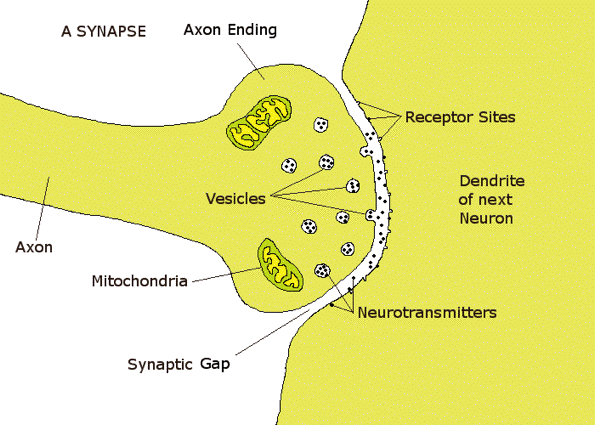
Figure 9.  When an electrical signal reaches the end of an axon, it causes the
release of neurotransmitters, which bind to the next neuron and initiate a new
electrical signal.
Neurons communicate with each other either through chemical or electrical synapses, but chemical synapses are more common, so we are going to focus on those.  A chemical synapse is the 30 nm (30 billionths of a meter) space between the axon of one neuron and the dendrite of another, across which different chemical messengers carry signals.  When an electrical signal reaches the end of the first neuron's axon, it causes these chemical messengers, called neurotransmitters, to be released, and these bind to receptors on the dendrites of other neurons, which in turn induce an electrical signal that propagates down the next cell.

Your neurons don't travel in a series of single-lane roads.  They often bundle together in parallel to form nerves.  Taste is carried to the brain by the trigeminal nerve and odor is carried by the olfactory nerve.  What happens once these signals reach the brain?  That's another story.

References: Recipe
None!  Original recipe!

References: Discussion
Our brains!

Tuesday, January 15, 2013

Experiment 11: Fried Rice

Figure 1.  Fried Rice.  Delish.
Introduction
What do you do when you have an extra four pounds of sushi rice sitting around?  Either you make way more sushi than you would want to eat, or you find another recipe that uses rice.  We chose to cook fried rice and created our own recipe.  After looking at some different fried rice recipes online and eating fried rice in a bunch of different restaurants, we figured out what we liked and didn't like to eat with rice, and chose what we wanted for our recipe (Fried Rice 2001, JingBat 2010).

This recipe was pretty painless to make.  Either it was a simple one, or we're getting better at cooking.  Just for fun, let's assume our neurochef skills are improving.  Here are our NFPA ratings for this recipe:
Figure 2. Our NFPA Ratings for fried rice.

Difficulty: This recipe gets a 2 because it wasn't that difficult.  Sure, you have to chop a few things, and mix a few things, but it's not that much work.  Furthermore, we had fewer vegetables to chop because we used pre-chopped, frozen carrots.  Don't judge, it saves time.

Preparation Time: 45 minutes.  We worked pretty efficiently on this recipe.  Of course, it helps to have four hands chopping and frying, but the entire production fit neatly into a 45-minute window.

Course: We ate our rice for dinner, but it could also make a great lunch.  Really, it's a fairly complete meal - chicken, rice, and vegetables.  For some people (mostly students), fried rice could even make a nice breakfast item.

Materials
Figure 3.  Vegetables: chopped, mixed, and cooking
1) Broccoli - around 8 pieces
2) Scallions - 4 stalks
3) Olive Oil - just pour some in the pans
4) Soy Sauce - 2.5 tablespoons
5) Frozen pea & carrot mix - 0.75 cups
6) Yellow Onion - half a chopped onion
7) Salt - just add some and guess
8) Rice vinegar (We forgot this one.)
9) Garlic - 3 cloves
10) Chicken - 2 breasts
11) Sushi Rice - 3 cups
12) Crushed Red Pepper - As much as you want

Procedure
Figure 4. CW from top right: rice, veggies, chicken, and pot
of unknown origin
1) Cook the sushi rice using the directions on the package.  Set aside.
2) Dice the chicken into .5 inch pieces.  In one frying pan, add some olive oil.  When the olive oil is warm, add the chicken to the frying pan and cook it.
3) Chop the broccoli, scallions, garlic cloves, and onion.  Heat some olive oil in a separate frying pan.  Add the peas, scallions, garlic, carrots, broccoli, and onions and cook them (Figure 3).
4) Add some salt and the crushed red pepper to both frying pans.
5) When everything is cooked, combine the chicken, vegetables, and rice into the largest frying pan and mix.  Add the soy sauce and continue mixing.  Best eaten hot.

Figure 5.  Everything mixed together.
Results
We were quite pleased with the very tasty results of this recipe (n=3), which was exciting because it was one of our first original recipes.  While eating, we compared our fried rice with restaurant fried rice.

At first, we thought the fried rice could have used a bit more seasoning, mainly salt.  Almost right away though, we realized that we were simply accustomed to eating salty fried rice at restaurants, and that our recipe was pretty delicious without all the extra salt.

We noted that in addition to being less salty than restaurant fried rice, our recipe was less greasy.  The only time we used oil was a small amount of olive oil in each frying pan.  When the oil looked like it was nearly used up, we added water (about one cup) to each frying pan.  Adding water prevented overcooking, kept everything moist, and reduced the amount of oil used.  Though many recipes used butter, we decided to leave it out since we weren't sure what it would add.

A third difference between our fried rice and restaurant fried rice is that we decided not to use eggs.  Rather than using some sort of egg substitute, like another thickening agent, we just left out the eggs.  It didn't seem to hurt the recipe at all.

Discussion

Why fresh vegetables taste better than frozen vegetables.

Fruits and vegetables are mostly water.  When these delicate plant products are put in the freezer, the water in their cells turns into ice crystals and expands, which causes the walls that define the structure of the cell to rupture.  Cell walls are unique to plants and some bacteria, and they serve several functions.  First, cell walls keeping the contents of the cell in place and control the transmission of molecules between areas.  Second, since cell walls are rigid, which keeps plants rigid, and therefore crunchy.  When a fruit or vegetable is frozen and its cell walls rupture, enzymes that normally break down cell waste migrate to places they are not supposed to be - remember, cell walls keep these sorts of things in place (Figure 6; America's Test Kitchen, 2012).  When said fruit or vegetable is thawed, these enzymes become active and wreak havoc wherever they have ended up.  As a result of the cell wall rupturing and enzymatic degradation, your fruits and vegetables turn into off-color, off-flavor, off-texture versions of their pre-frozen selves.
Figure 6. The effects of freezing and thawing tobacco leaves. A) Fresh tobacco
leaf cells. B) Frozen leaf cells, exhibiting extensive rupturing. C) Magnification of
B, showing collapse of cell wall (arrow).  D) Thawed leaf, showing complete
disruption of cell structure.  Borrowed from Pearce, 2001.

This seems like a problem, right?  It looks like nature's way of continuing to ensure that nothing comes easy.  Sometimes you don't have the patience to cut up vegetables when the pre-chopped frozen alternative is a few aisles down.  Or, you might not have the energy or time after a long day at work to refine your knife skills with endless chopping, slicing, and mincing.  So how do you solve this conundrum?

Fortunately, vegetable manufacturers have solved this problem for you!  When you buy frozen vegetables at the store, they come blanched (America's Test Kitchen, 2012).  Blanching is the process of dipping a frozen food into boiling water, and then removing it after a short time and putting it in cold water to stop the cooking process.  Blanching breaks down all of the enzymes that would otherwise destroy your foods from the inside out without cooking the food itself.  The vegetables therefore maintain their color and taste - this is why your peas, carrots, peppers, broccoli, and other vegetables are brightly colored when they come out of the bag.

Problem solved!

References
1) 2001. "Fried Rice." Television Food Network, G.P.
2) JingBat. April. 2010. "Meegol's Fried Rice." VegWeb.
3) America's Test Kitchen. 2012. The Science of Good Cooking. Brookline, MA: America's Test Kitchen. Print.
4) Pearce RS. 2001. Plant Freezing and Damage. Annals of Botany 87: 417-24.

Tuesday, December 25, 2012

Experiment 9: Deep Dish Pizza

Figure 1. Delicious Deep Dish Pizza
Introduction
One of the big Chicago traditions we cherish is eating deep dish pizza, especially from Lou Malnati's.  From non-Chicagoans (Read: New Yorkers), we've heard  deep dish pizza be compared to everything from a casserole to lasagna without the pasta.  However, as two people who grew up with the cheesy, saucy goodness of deep dish, we tell you now: pizza isn't a real meal unless you have to eat it with a fork and a knife.

For those of you who have never experienced the glory of deep dish pizza, we implore you to come to Chicago and try it yourself.  If you don't have the opportunity to do so, we hope we can provide you with a piece (or eight) of heaven on a plate with our recipe.

Our NFPA Ranking:
Figure 2. Our NFPA Ratings for deep dish pizza.

Difficulty: We ranked this recipe a 6 because it has multiple steps that a neurochef needs to coordinate in order to maximize efficiency.  The steps themselves aren't complicated, but you have to put them together properly.

Preparation Time: This recipe takes about two hours and fifteen minutes to complete.  We found it helpful to chop the tomatoes while the pizza dough was rising and to make the sauce when the dough was cooking.  Chopping four large tomatoes isn't instant, so allow for some time.

Course: Deep dish pizza is best eaten during lunch or dinner.  It's not sweet, so dessert is out of the question, and it's a bit too heavy for a midnight snack.

Materials
Figure 3. The dough after some thorough kneading.
Pizza Dough:
1) Warm Water - 1 cup
2) Active Dry Yeast - 1 package
3) Sugar - 1 teaspoon
4) Vegetable Oil - 1 tablespoon
5) Eggs - 1
6) Flour - 3 cups

Figure 4. Spices for the Pizza Sauce


Sauce:
1) Large, Fresh Tomatoes - 4
2) Olive Oil - 2 tablespoons
3) Garlic Power - 1 tablespoon
4) Italian Seasoning Blend - 2 teaspoons
5) Salt - .5 teaspoon
7) Ground Black Pepper - .25 teaspoon
6) Ground Red Pepper - .25 teaspoon

Cheese & Toppings:
1) Pizza Cheese (Mozzarella and Cheddar Mix) - 1 package
2) Other Toppings

Figure 5. Simmering the Sauce
Figure 6. Pizza Dough.  It should be thinner than this.
Procedure
Pizza Dough:
1) Pre-heat oven to 350 ºF.
2) Mix warm water, yeast, and sugar in a bowl.
3) Add the vegetable oil and the egg to the bowl.  Mix.
4) Add the flour one cup at a time.  Additional warm water can be added to help mix the flour into the dough.
5) Knead the dough (Fig. 3).
6) Put the dough in a covered bowl and let it sit for one hour.
7) Grease the pizza pan.
8) Place the dough in the pan by spreading it over the surface and then pinching it up the sides to form the crust (this also creates a bowl for your sauce and toppings).
9) Bake the dough at 350º F for 30 minutes.

Sauce:
1) In a skillet, simmer together the olive oil and garlic.
2) Add the herbs and spices (Fig. 4).
3) Turn up the heat and add the tomatoes and sugar.
4) Simmer until all of the flavors meld together to become one succulent sauce (Fig. 5).

Building the pizza:
A Chicago-style deep dish pizza is built in the opposite order from a traditional pizza.

1) Apply a healthy layer of cheese to the crust.
2) Put down a thick layer of your favorite toppings.
3) Finally, pour a layer of sauce on top (Fig. 7).
4) Bake the entire pizza for an additional 15 minutes at 350 ºF.
Figure 7. Pour the Sauce onto the Pizza Dough and Cheese.
Results
We did it!  It is in our hands...the knowledge that we lowly students have what it takes to recreate one of Chicago's defining culinary traditions.  You'll notice from the pictures (proof!) how real this is.

Actually, wait a moment.  To provide you with a painfully alluding reminder: pictures can deceive.  Although it looks more or less like a traditional Chicago-style deep dish pizza, it tasted quite different.  Don't get us wrong, it was still amazingly delicious, but it just wasn't what we expected, and probably wouldn't meet the standards of the Malnati family.

First, let's chat about the crust.  It rose as we expected during the allotted time.  However, baking the crust induced a tad bit more growth.  More specifically, the crust puffed up about an inch.  Instead of being a mere centimeter in thickness which would yield an ideal surface area to volume ratio, we ended up consistency similar to a soft pretzel.  In fact, the dough tasted like a soft pretzel.  While this was not what we expected, it was still quite flavorful.  We were left wondering how Lou Malnati's manages to get such a perfectly shaped crust every time.  Sure, they're experts, but it almost seems like they must have a mold that they use to hold the crust in place as it cooks.

In order to compensate for this unexpected turn of events, we skimped a little on the cheese.  In hind site, the proper way to compensate probably would have been to add more cheese.  Normally, the crust to cheese thickness ratio is roughly 0.5 to 1 or 1 to 1, but for our pizza, the ratio was more like 9:1.  Regardless, we still got goopy, picturesque cheese, just not as much.

Next, the sauce.  It turned out more like bruchetta-esque tomato sauce than pizza sauce.  Chunky, peppery, and savory.  Yum.  However, for the sake of education, we should tell you that we did this all wrong.  The best deep dish sauces are prepared raw and aren't cooked until put onto the pizza.  We broke the rules, but don't blame us, we were just following directions.

Figure 8.  Our final product, with a dash of cheese on top for effect.
Discussion
We want to take this opportunity to talk to you about cheese, that fatty, cholesterol-filled food that contributes to so many of our favorite foods, especially deep dish pizza.  Cheese is an intriguing food, as after it was invented by accident in ancient times, it has worked its way into different cuisines all over Europe and the Americas in different forms.  To make foods like pizza, cheese has to be melted.  How does that happen?  Let's start with how cheese is made.

We all know that cheese comes from milk.  Milk is primarily made up of water, protein, fat, and sugar (Martinez 2012b).  In ancient Mesopotamia, milk was carried in pouches made from animal stomachs (Martinez 2012a).  To the surprise of many, after some time, solid globs would start to separate from the liquid in the milk.  These globs, or curds, were made of protein and fat, while water and sugar formed the whey.  It was discovered that the curds could be eaten, and thus cheese was born.

How did the curds form in the first place?  It turned out that the animal stomachs that were used as pouches contained rennet, a type of enzyme that replaces the water that is bonded to milk proteins with fat (Martinez 2012b).  Because of the presence of rennet, after some time incubating in the dry heat, the protein and fat bound together and coagulated.

When you heat cheese up, the fat and protein in the cheese separate (Martinez 2012c).  This is why cheese "sweats" oil and becomes slick when it is heated up.  Unfortunately, cheese loses its flavor when the protein and fat separate.  This is not a problem in pizza (or your grilled cheese, for that matter), because the starches in the dough will help hold the two molecules together.  Grating your cheese helps retain the flavor, as well as including a small amount of liquor.

Future Directions
Coming soon: Fried Rice!

References
1) Baker, S. (Dough)
2) Dryden, S. 2012. "Recipe for Lou Malnati's-Style Deep Dish Pizza." Roaming Indigo. (Sauce)
3) Martinez L. 2012. Cheese in Ancient Times. Netplaces.
4) Martinez L. 2012. Curds, Whey, and Rennet. Netplaces.
5) Martinez L. 2012. How Cheese Melts. Netplaces.

Figure 9. Getting hungry yet?

Tuesday, December 18, 2012

Experiment 8: Potato Latkes

Figure 1. Perfectly cooked latkes: burnt on the outside,
warm on the inside.
The Great Potato Massacre!

Introduction
What's the best way to celebrate the end of finals?  A latke party with your neurobuddies, of course!  Potato latkes are a traditional Jewish food that is eaten during the festival of Hanukkah.  However, just because Hanukkah is over, that doesn't mean that you have to wait another year to cook these.  In addition to Ashkenazi Jewish cuisine, latkes can be found in established cuisines all over eastern Europe.  Typically, latkes are primarily composed of potatoes and onions, but for our neurofiesta, we welcomed several new variations on the dish from fellow neurochefs.  Aside from traditional latkes, the stove saw the frying of three other varieties: Purple potato and celery root latkes, sweet potato latkes, and parsnip latkes. All of these varieties involved the same general procedure, just with different materials.  Here, we will focus on the standard latke recipe.


Our NFPA Ratings (Fig. 2):
Figure 2. Our NFPA Ratings for potato latkes.

Prep Time: This varies depending on the amount you are making, because shredding potatoes and onions takes time.  On the short end, preparing and frying will take 30 minutes all together, but with the amount we made, it took about an hour.

Difficulty: Making latkes is a lot like making dough, in that it it involves a few, common ingredients to put it all together.  Having said that, shredding potatoes can be a pain in the butt, but that is perhaps more of a complaint than a criterion for assessing the difficulty of preparing latkes.  Just be patient; only flip them when they are ready.

Course: Depending on the cuisine, latkes can either accompany a meal as a delicious side, or they can comprise the main course.  It all depends on your eating habits and they way you cook your latkes.


Figure 3. Step One: shred the potatoes
Materials
1) Yellow potatoes* - 4 lbs.
2) Eggs - 4 (1 egg per lb. of potatoes)
3) Chopped or shredded white or yellow onions** - 1 cup
4) Flour - 1 cup
5) Salt - 2 tsp
5) Olive oil - a lot

*Can be replaced with sweet potatoes
**Can be replaced with celery root

Procedure
1) Shred the potatoes and onions in a food processor or salad shooter, and place the shredded pieces in a bowl of cold water (Figure 3).
Figure 4. Strain and dry.
2) Drain all the water out of the potatoes (Figure 4).  Dry them as much as you can, then return them to a dry bowl.
3) Add the onions, eggs, and flour.  Mix!
4) Put a non-stick frying pan on medium to medium-high heat, and coat the surface with olive oil.
5) Scoop spoonfuls of the potato mix into the frying pan and flatten them into 3-inch circles while making sure they still sick together. Thinner latkes fry faster and are tastier (Figure 5).
6) When the bottom edges look burnt, flip the latke to brown or burn the other side.  When it's done, remove it from the frying pan.  Best served hot....straight from the frying pan.

Top with apple sauce, sour cream, or sugar for additional flavor.


Figure 5. Clump together and flatten for best results.
Figure 6. Top left: Sweet potato latkes starting to cook.
Top right: traditional latkes finishing up.


Results
When you are cooking latkes, the key is to make the oil hot enough.  The trick is to burn the outermost layer of the latke for texture, while leaving the middle only moderately cooked, in order to preserve the taste of the potato.  Fortunately, cooking dozens of latkes gave us the opportunity to learn this over time.  At first, we put the stove on medium heat, and not only did our latkes take a long time to cook, but the potatoes had a terrible time browning.  Our undercooked latkes fell apart and gave way to hash browns (Figure 8).


Figure 7.  Pretty Latkes!
After we turned up the heat to medium-high, everything really started cooking.  The bottoms burned, which made flipping much easier, made for much prettier latkes, and gave them a good crunch (Figure 7).  However, at this level of heat, our oil started to boil.  As a result, we went through a bit more oil than we had first anticipated (Goodbye, barely used bottle).

It was all worth it.  Why?

THEY WERE DELICIOUS!  They were full of that oily, onion-y flavor of our childhoods.  Straight from the pan, these golden beds of flavor lit up our taste buds and flooded our brains' reward systems with a deluge of dopamine.  Although it sounds counter-intuitive, burning the faces of the latkes brought forth a new dimension of texture that rounded out the experience.  Although we started with our own recipe, we re-discovered how to make the kinds of latkes that would have lived up to the expectations of our ancestors.

How many did we make?

A lot.  Dozens.  We lost count because they were so delicious that everyone, human (n=16) and non-human (n=1) ate them as soon as they left the frying pan.  The leftover scraps from the pan, if they were not too burnt, were just as delicious, and were eaten just as quickly.  To be fair, we doubled the recipe to feed 16 hungry mouths.  One neurobuddy hung around the kitchen just collect the scraps from the frying pan.  Others crowded around the entrance to the kitchen so they could be first to devour the newly fried latkes.

Figure 8.  After a few rounds of cooking, a pile of hash browns started to
accumulate in the pan.
Discussion
We made this recipe up based on a review of a dozen or so other recipes.  While risky, this approach gave us the freedom to apply a fair amount of critical, scientific discussion to our choice of ingredients and cooking methods.

Science Part I: Food Chemistry
A few of our fellow neurochefs recommended that we submerge the potatoes in water after chopping them up.  Not surprisingly, we were curious about the effects of this submersion on the potatoes.  After a bit of research (mostly internet surfing), we learned that soaking chopped potatoes in cold water prevents discoloration of the potato pieces.  The cells that make up a potato contain an enzyme (protein that catalyzes reactions) called polyphenyl oxidase (Figure 9).  When oxygen contacts this enzyme in an oxidation reaction, potatoes turn brown (Helmenstine 2012).

Figure 9. Oxidation and Discoloration (Rotter 2011)
One way to prevent this oxidation reaction, and thus prevent the chopped potatoes from discoloring, is to submerge them in cold water (Helmenstine 2012).  This prevents the polyphenyl oxidase from coming into contact with oxygen.  Another way to prevent discoloration is to lower the pH of the potato's surface by adding lemon juice and creating an acidic environment in which the oxidation will either happen more slowly or not happen at all.

Science Part II: Neuroscience!
Figure 10. The Olfactory System
(MedicaLook: Your Medical World 2012)
Latkes have a certain smell, the smell of onion mix with that of fried foods.  It's the kind of smell that hangs around the house for a week.  So what's up with smells and science?  For starters, smell is the sense that is most closely tied to memory.  The senses of taste, vision, hearing, and touch all take a wayward route the sensory cortex in the brain, but the sense of smell heads straight there from your nose.  The area of the brain that is responsible for accepting smell signals is called the olfactory bulb (OB; Figure 10).  The OB sends this information straight to the memory center and reward center of the brain, thereby allowing people to make very strong associations between latkes, through their strong scent, and the people and places that were around when they were made.  This type of memory is called associative memory, because it's a learned association between two different stimuli, i.e. the smell of latkes and the environment in which you ate them.

For us, that means the smell of latkes instantly triggers memories of the people we ate them with as children.  Everyone has those foods, foods that their parents or grandparents made when they were kids, comfort food, the kind that returns feelings of warmth and pleasure.  It's all because of associative memory.  It could be the sight of cookies, the sound of boiling tea, or the texture of a braised beef on your tongue.  This phenomenon applies to all of the senses, but the sense of smell confers the strongest associations.

Future Directions
Coming soon: Deep dish pizza!

Acknowledgements
We would like to thank Kyler and Adam for coming up with the idea for holding a neurolatke party.  We would like to thank Jeff, Joe, and Carla for letting us borrow their food processors, Kyler and Cummings for cooking the purple potato and celery root latkes and recommending the use of yellow potatoes, and Tahra (Pi(e) Princess!) for cooking the parsnip and sweet potato latkes.  An additional thanks goes to Kyler for coming up for inadvertently coming up with the subtitle for our article.  We would also like to thank Alex for his very expressive positive feedback, Huey for licking the crumbs off the floor, and everyone else for attending the 2012 Neurolatke Conference!  This project was funded (very indirectly) by the Biological Sciences Division at The University of Chicago. 
 
Supplementary Materials  
Figure 1. Sliced purple potatoes, ready for shredding.
Figure 2. Sweet potato-apple mix.
References
1) Helmenstine, A.M. 2012. "Why do Cut Apples, Pears, Bananas, and Potatoes Turn Brown?" About.com Chemistry Edition.
2) 2012. "Olfactory Sense Anatomy." MedicaLook: Your Medical World.
3) Rotter, B. 2011. "Sulphur Dioxide." Improved Winemaking.